You're Paying Every Month to Stream Music You Already Own
September 28, 2026
There’s a line on most bank statements that nobody reads anymore: $12.99, Spotify. Or $11.99, Apple Music. Or $11.99, YouTube Music. It’s been there so long it feels like a utility bill — the price of having music in your pocket.
And somewhere, on an old laptop or an external drive or a shelf, there is a music collection that the same person paid for years ago. Albums bought on iTunes. CDs ripped in 2006. The whole thing, sitting there, while its owner streams the same songs back from a service at $156 a year.
This isn’t an argument that streaming is bad. It’s a genuinely great product for some people. It’s an argument that a lot of us are paying for something we mostly don’t use, to listen to music we mostly already have — and that it’s worth checking which kind of listener you actually are.
The price only moves in one direction
For a long time, $9.99 was the price of streaming music. That ended in 2023. Since then:
| Service (US, individual) | Price now | Family plan |
|---|---|---|
| Spotify Premium | $12.99 | $21.99 |
| Apple Music | $11.99 | $19.99 |
| YouTube Music | $11.99 | $18.99 |
| Amazon Music Unlimited (non-Prime) | $12.99 | $21.99 |
Spotify has raised its US price three times since July 2023 — about 30% in two and a half years. Apple raised Apple Music in July 2026, its first increase since 2022, citing licensing costs. YouTube Music went up in April, and Amazon raised its prices twice in about a year.
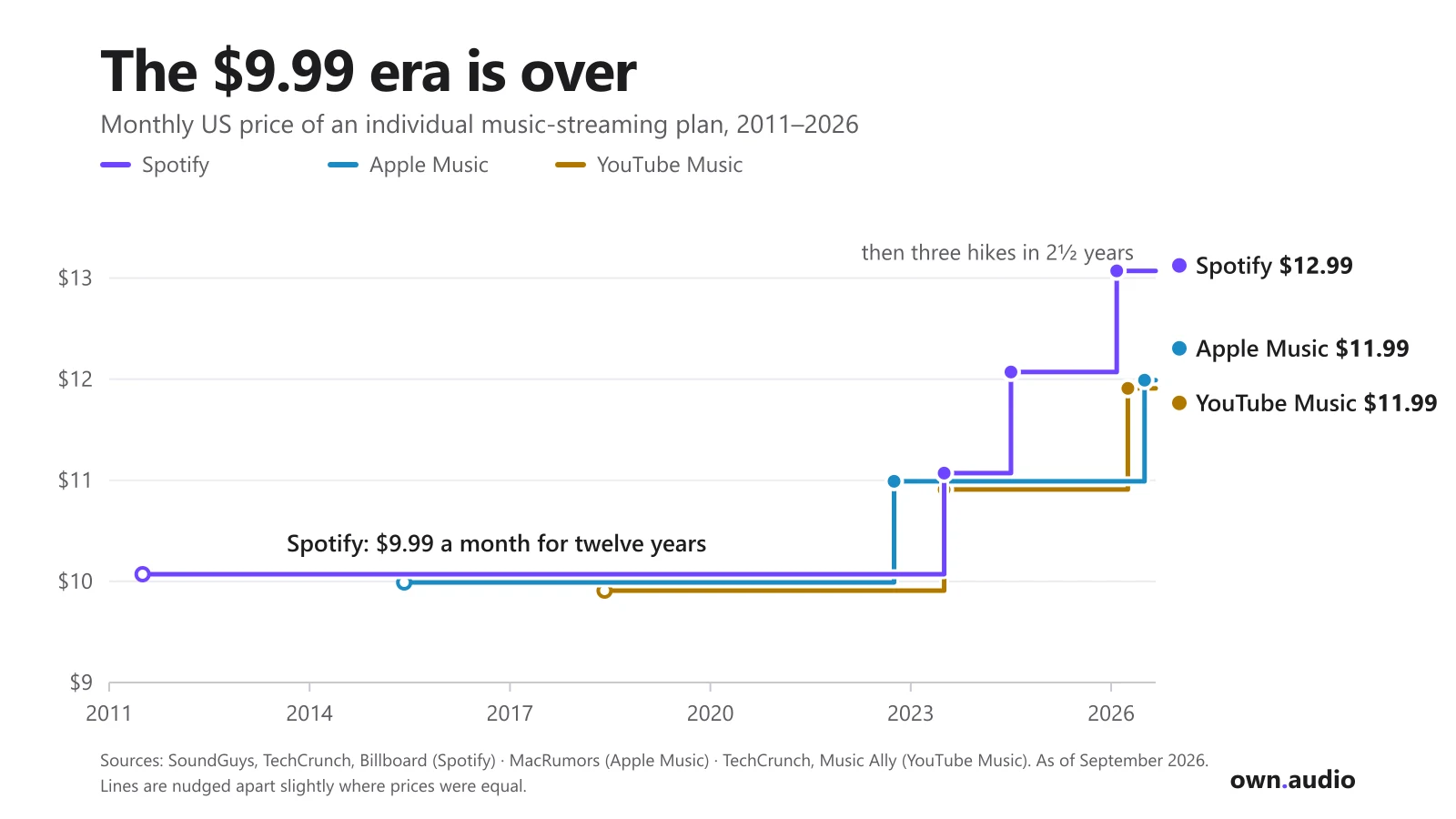
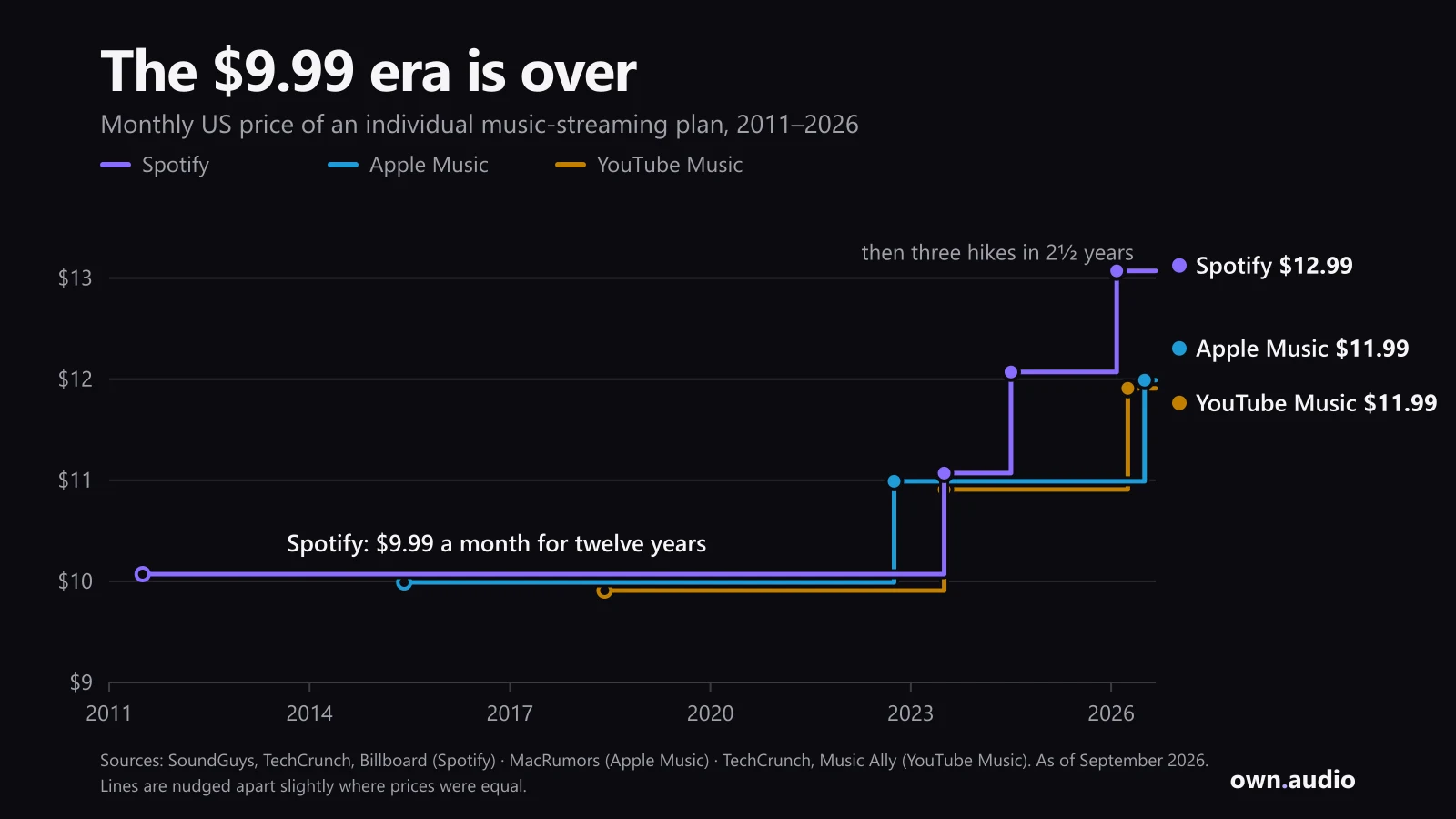
Add it up for someone who has had Spotify Premium since 2016 and it comes to roughly $1,350. For a family plan, more than double that. None of it buys a single file you get to keep.
Most of what we stream, we’ve heard before
The case for streaming is the catalog: a hundred million songs, instantly. The interesting question is how much of that catalog people actually touch.
Spotify’s own researchers looked at this. In a study of more than 8 billion listening events from 100,000 US Premium subscribers, they found that listening “is generally consistent with heavy repeated consumption” and that “repeat listens outstrip discoveries.” Over a subscriber’s history, unique tracks made up only 16–26% of their streams, depending on age group. Put the other way round: roughly three out of every four plays were songs the listener had already played before.
Spotify’s subscribers aren’t unusual here. A 2021 study of Last.fm listening histories found that users relisten to tracks they’ve already played 66% of the time on average, and play a single track 111 times. Last.fm users skew towards music enthusiasts, so treat that as an upper-middle estimate rather than a universal one, but it lands in the same place as Spotify’s.
The industry-wide numbers point the same way. In 2024, catalog music — anything older than 18 months — made up 73.3% of US music consumption, according to Luminate. In 2025, only 43% of US streams were of songs released in the previous five years.
And people feel it themselves. In a 2018 survey commissioned by Deezer, 60% of 1,000 UK adults said they felt stuck in a musical rut. That’s one survey, run by a streaming company, and Spotify’s larger study doesn’t agree with its headline claim that discovery stops at 30 — but the rut itself will sound familiar to anyone who has opened a streaming app, scrolled past the recommendations, and put on the same playlist as yesterday.
What does that repeat listening look like? Not, for most people, a tiny top ten. Deezer researchers who studied a year of plays found that roughly 80% of them were chosen by the listener — search, favourites, their own playlists — rather than handed over by an algorithm or an editor. And in a 2016 survey of 3,014 US adults, playlists took up 31% of people’s listening time and albums 22%, while single tracks were still the most popular way to listen. It’s self-reported and old, but it matches how it feels: a few playlists and albums you know well, played around and around, with the occasional detour.
We couldn’t find anyone who has measured that last part properly — how much of a person’s listening goes to their top two or three playlists. The evidence is indirect, so we’re not putting a number on it.
That’s not a failing. Coming back to the music you love is most of what listening to music is. It just means that for a lot of people, the product they pay for — infinite choice — is not the product they use.
A lot of it, we already bought
Here’s the part that stings. Before streaming, people bought music. A lot of it.
Apple announced in 2013 that the iTunes Store had sold more than 25 billion songs. Since 2009, music sold there has come without DRM — plain AAC files you can download, copy, and keep. Add the CDs: US buyers still purchased 29.5 million of them in 2025, on top of decades of shelves filled before that, and 48% of Americans say they like buying physical copies of their music.
Now think about which songs make up those three-quarters of repeat listening. For most adults, it’s the music they fell for in their teens and twenties — exactly the era when they were buying albums. The albums that shaped your taste are very often the albums you own.
So the typical pattern looks like this: a person pays every month for a service whose main job, in practice, is to play them music that is already sitting on a drive in their house.
What the subscription actually buys you
To be fair to streaming, it does three things well:
- Discovery. New releases, recommendations, other people’s playlists. If you listen to a lot of new music, nothing else comes close.
- Convenience. One app, every device, no files to think about.
- Breadth for the moment. The song someone mentions at dinner is right there.
What it doesn’t buy is permanence. You’re renting access, and access changes. Tracks go grey when licences lapse in your region. Whole catalogues leave: in 2022, Neil Young and Joni Mitchell pulled their music from Spotify, and it was gone for two years. Cancel the subscription and your playlists — often years of careful work — become a list of songs you no longer have.
The files on your old drive don’t do any of that. They just need somewhere convenient to live.
The arithmetic of keeping your own
The reason people drifted from their own collections to streaming was never price. It was friction: the music was stuck on one computer, syncing a phone was a chore, and sharing it with the family was impossible. That’s a storage-and-apps problem, and it’s a much cheaper problem to solve than it looks.
A four-minute song at iTunes quality (256 kbps AAC) is about 7.7 MB. So:
| Your library | Storage | At $0.05 per GB per month |
|---|---|---|
| 1,000 songs | ~8 GB | ~$0.40 / month |
| 5,000 songs | ~38 GB | ~$1.90 / month |
| 10,000 songs | ~77 GB | ~$3.85 / month |
| 10,000 songs in lossless FLAC | ~270 GB | ~$13.50 / month |
A 5,000-song library — a serious collection, more than most people ever play — costs less per month than a coffee, and it’s the same price whether one person listens or a whole family does. The last row is there for honesty: if you keep everything in lossless, your own library can cost as much as a subscription. Storage is the cost; the format is your choice. (For how storage pricing works in general, see what it actually costs to store your audio.)
What it costs a family — and what the difference buys
Take a household with a real collection: 5,000 songs and 30 audiobooks. At iTunes quality the songs come to about 38 GB. A typical ten-hour audiobook is around a third of a gigabyte, so the books add about 10 GB. Call it 48 GB in total.
| For the whole family | Per month | Per year |
|---|---|---|
| Spotify Premium Family | $21.99 | $263.88 |
| Apple Music Family | $19.99 | $239.88 |
| YouTube Music Family | $18.99 | $227.88 |
| Your own 48 GB library, at $0.05 per GB | ~$2.40 | ~$29 |
Against Spotify’s family plan, that’s about $235 a year. The comparison isn’t perfectly like for like: a streaming family plan gives everyone their own account and the whole catalog, while your own library gives everyone the same shared collection, and only the music you own.
So spend the same money anyway. Keep setting aside $263.88 a year, pay the storage out of it, and use the $235 that’s left to buy music outright. At the iTunes Store’s standard prices of $9.99 for a full album or $0.69–$1.29 a song, that’s about 23 albums a year, or roughly 180 individual songs, chosen by whoever in the family wants them. The new music adds about 2 GB a year, around ten cents a month in storage.
After five years, both households have spent about the same, roughly $1,300 at today’s prices. One of them has a subscription that ends the month it stops paying. The other has its original library plus about 115 albums it owns for good.
And if there’s an Audible subscription too
Plenty of households pay for audiobooks on top of music. Since March 2026 Audible has two plans in the US, and they are very different deals.
Audible Standard costs $8.99 a month: one audiobook a month plus a curated library, and you keep access to a title only “for as long as membership remains active.” That is a rental, exactly like music streaming. Add it to Spotify Family and the household is paying $371.76 a year for audio it doesn’t get to keep.
Audible Premium costs $14.95 a month for one credit, and “any title you get with a credit is yours to keep.” That is closer to buying, so it isn’t fair to count it as money wasted. The catch is where the book lives: inside Audible’s app, locked with DRM, so it can’t move into a library of your own. If you’d rather own audiobooks as files, stores like Libro.fm sell the same mainstream titles DRM-free, as downloads you keep.
The 30 audiobooks in the example above are exactly that kind of file: bought once, stored once, and shared with everyone in the family.
When streaming is worth every cent
Keep your subscription if:
- You discover constantly. If most of what you play this month didn’t exist in your life last month, streaming is the right tool and a bargain for what it does.
- You don’t own much. If your collection is fifty albums you haven’t touched since 2010, there’s nothing to go back to.
- Your household runs on shared playlists and new releases. Teenagers, especially.
There’s also a middle path that works for many people: keep your own library as the base you listen to every day, and subscribe only in the months you’re actively exploring. Or skip the subscription and buy the few new albums a year you truly love outright — $156 a year buys about fifteen $10 albums, and those you keep forever.
Where own.audio fits
This is the problem we’re building own.audio for. It’s a private cloud home for the audio you already own — music, audiobooks and podcasts — with apps for your phone, your computer and the browser, one library shared across the whole family, and no subscription: every app is free, and you pay only for the storage your library uses. For people who’d rather use their own music player, we’re also building compatibility with OpenSubsonic apps.
It isn’t available yet — we’re in development, and you can see exactly where we are on the roadmap. If the idea of listening to the music you already paid for, on every device, without a monthly fee sounds right, join the waitlist and we’ll tell you when it’s ready.
And whatever you decide: before you pay for another year of streaming, go and find that old drive. Your music is probably still there.